Haitian mini-jazz, written mini-djaz in Haitian Creole, was the wave of small, young, electric bands that took over Haitian dance music from the mid-1960s. Groups such as Les Frères Déjean, Shleu-Shleu and Tabou Combo cut the big kompa orchestra down to two guitars, three percussionists and a saxophone, then carried that sound to New York, Montreal, France and the French Antilles. The band format they settled on held, with small changes, for generations.
A name coined at Cabane Choucoune
Cabane Choucoune, in the hillside suburb of Pétion-Ville, was the club where Nemours Jean-Baptiste had built a Saturday-night following among Port-au-Prince’s elite. In the mid-1960s a band of students called Shleu-Shleu played there, and Nemours, the man credited with founding kompa, gave their kind of group a name: mini-djaz.
The ethnomusicologist Gage Averill tells the story in a history of kompa published by the Médiathèque Caraïbe (Laméca) in Guadeloupe. Nemours wanted to separate this small, rock-flavoured combo from his own large konpa-dirèk orchestra. Averill adds a period detail: it was the age of the miniskirt.
The label stuck. By the end of the decade, small electric groups like Shleu-Shleu had won Haiti’s young audience away from the great orchestras.
Haiti’s dance orchestras before the mini-djaz
To understand what “mini” meant, start with djaz. From the late 1920s, Haitian dance bands borrowed the American word: Jazz Guignard, Jazz Duvergé, Surprise Jazz and many more. Over time djaz, the Creole spelling, came to mean any large dance orchestra. A mini-djaz is a small dance band: the name describes its size, not its style.
By the late 1950s the leading djaz were full ensembles. Nemours’s band paired saxophones and trumpets with an accordion, a string bass, a hand drum and a singer on maracas. Nemours launched his konpa-dirèk (French compas direct, roughly “straight beat”) in 1955. Around 1959 his former bandmate, the saxophonist Webert Sicot, answered with a near-identical rhythm he called kadans-ranpa.
Their feud defined an era that Haitians nicknamed the épòk polémik. The two bands traded insult songs, wore rival colours at carnival, and in 1964 even met in a football match at Port-au-Prince’s Stade Sylvio Cator in front of 35,000 fans. It finished 1–1. According to Averill, their dominance ended around 1967–68. For the full origin story of the parent style, see our guide to what Haitian kompa is.
Yéyé: the teenagers plug in
In the early 1960s, middle-class teenagers in Port-au-Prince and Pétion-Ville started playing rock and roll and other imported styles without giving up kompa. People called their combos yéyé. Averill’s account in the Laméca dossier traces the word to the “yeah, yeah, yeah” refrain of the Beatles’ “She Loves You”. The bands carried names like Les Copains, Les Jets, Les Vampires, Les Blousons Noirs and Les Loups Noirs, and they played cinemas, high-school dances and Radio d’Haïti, whose broadcasts carried new sounds across a country where many people could not read.
The yéyé bands played their own repertoire, kompa hits included, in a reduced lineup. To that lineup they added congas and a cowbell. Averill identifies this stripped-down format as the backbone of what people soon called the mini-djaz.
Who came first?
Short accounts of Haitian mini-jazz history often credit Shleu-Shleu with launching the movement in 1965, but small electric combos were already working. In 1962 the Hôtel Ibo Lélé assembled a group of yéyé musicians, later renamed Ibo Combo; the word combo nodded to small jazz groups and Brazilian bossa nova bands. Les Frères Déjean followed in 1963. Shleu-Shleu’s achievement was to turn the format into a craze and give it the name that stuck.
Les Frères Déjean: two brothers from Pétion-Ville
In 1963 two Pétion-Ville brothers, André and Fred Déjean, formed a band first known as Les Frères de Pétion-Ville. André played trumpet and Fred played saxophone, so the group kept a brass voice that most mini-djaz dropped in favour of a single saxophone.
Averill describes the Déjeans as the band that listened hardest to what was happening in the United States, Martinique, Guadeloupe and Cuba, and notes that they were much loved in the French Antilles. The brothers kept the group going for decades, releasing an album on Marc Records in 1974, eleven years after their debut, and often backed other mini-djaz.
Shleu-Shleu and a new rhythm section
Shleu-Shleu formed in 1965 among students from Bas-Peu-de-Choses, a middle-class district of Port-au-Prince, under the direction of the alto saxophonist Tony Moïse. A businessman, Dada Jacaman (also spelled Jackaman), became manager early on and promoted the band hard. Shleu-Shleu went full-time and began recording. Its first album came out in 1967 on Joe Anson’s Ibo label and includes the instrumental “Compass X”, a showcase for Moïse’s lead saxophone.
Averill credits the band with three lasting changes to the kompa sound:
- The drum kit. Drummer Smith Jean-Baptiste played a decisive part in bringing the full kit into kompa.
- Electric atmosphere. Guitarist Serge Rosenthal brought new levels of echo and reverb to the music.
- A Haitian saxophone voice. Moïse and his successors created an original, recognisably Haitian alto saxophone sound.
Credit for the rhythm section was shared, though. Averill attributes the strict five-note hi-hat pattern of mini-djaz kompa to Herman Nau of Tabou Combo. The modern kompa rhythm section came out of several bands at once.
How the mini-djaz rebuilt kompa
Averill’s breakdown of the classic lineup shows how far the young bands reorganised the music.
Three percussion parts instead of one
- Tanbou (conga): plays the basic konpa-dirèk rhythm.
- Hi-hat: plays a pattern based on kata, a five-note rhythmic figure from rara, the music of Haiti’s Lenten street processions, and drops in surprise breaks.
- Cowbell and floor tom: a third player locks a two-bar pattern across both.
Guitars at the centre
A rhythm guitar and a lead guitar carry the chords and the main melodic lines, the job the accordion and horn section had done in the big orchestras. The alto saxophone, later a full horn section, trades phrases with the singer. Some bands bent the formula: Tabou Combo added an accordion, Les Frères Déjean kept a trumpet. Most stuck to the basic plan.
You can hear the guitar interplay at its most developed in “Courage”, the 1973 hit by Les Gypsies de Pétion-Ville. Averill points to Robert Martino’s lead guitar riding over Reynold Nadere’s rhythm part as a muscular improvisation on two chords, a signature of the line that ran from Les Difficiles de Pétion-Ville to the Gypsies and D.P. Express.
A youth market with its own rules
The mini-djaz specialised in light dance music for teenagers, though they also recorded patriotic and romantic ballads. By the late 1960s the most popular among them, including Les Difficiles, Tabou Combo, Shleu-Shleu and Les Ambassadeurs, were releasing up to two albums a year and playing carnival from cha, the tractor-drawn floats. Averill notes that most of the leading Haitian musicians of the 1970s and 1980s started out in these pre-1970 bands.
Playing under the Duvaliers
The mini-djaz grew up under dictatorship. François “Papa Doc” Duvalier’s government had already used carnival and state-sponsored street parties, called koudyay, for political display, and the big orchestras were hired or pressed into playing them. When Duvalier died in 1971, his son Jean-Claude took over. Averill describes “Baby Doc” as a mini-djaz enthusiast who hired bands for parties at the National Palace and frequented Pétion-Ville’s nightclubs. Bossa Combo became known as the president’s house band.
In the 1970s carnival boomed and tourism returned, and professional musicians earned a better living. Les Difficiles de Pétion-Ville split into two rivals, D.P. Express and Les Gypsies. In the early 1980s some leading bands based in Haiti began to distance themselves from the regime. Bossa Combo, once the house band, was among the first. D.P. Express went further. In 1979 it had recruited the singer Ti-Manno, back from playing with mini-djaz in Boston, and Averill identifies it as the first mini-djaz in Haiti to put critical messages in its songs.
Mini-djaz across the water
Haitians speak of life abroad as lòt bò dlo, “the other side of the water”. Haitian dances were already running abroad by the late 1960s, and young Haitians who had gone to New York to study formed bands to entertain homesick compatriots at weekend dances. Averill describes these community gatherings as a way of binding together the koloni, the Haitian colonies abroad.
Two of the biggest names crossed with them. A United States version of Shleu-Shleu, led by guitarist Serge Rosenthal, formed in New York and later split to create Skah Shah #1. Almost every member of Tabou Combo either emigrated and refounded the band in New York or joined the others once it was established there. New rivalries, Tabou against Shleu-Shleu and later Skah Shah, played out in New York first, then in Miami, Boston, Montreal and beyond.
Homesickness became a subject in its own right. Skah Shah’s 1975 song “Haïti” sets a migrant’s loneliness in New York against wailing sirens and borrows the melody of “Ayiti Cheri”, a classic song of exile. It also uses the greeting Mezanmi, kouman nou ye? (“My friends, how are you?”), a phrase associated with the spirit Papa Gede in Vodou ceremonies. Averill later took that line as the title of his 1994 study of how music holds the Haitian “transnation” together.
Tabou Combo takes kompa abroad
Tabou Combo began in Pétion-Ville in 1968 as a teenage mini-djaz, first under the name Los Incognitos. Its breakthrough came with “New York City”, from the 1975 album 8th Sacrement. According to Averill, the song sold more than a million copies in France and became a major hit there and in the French Antilles, a first for a Haitian band. Versions of the album and single appeared in the United Kingdom, Germany and even Turkey. Averill notes the band earned very little from the hit, but it made Tabou Combo the leading name in Haitian music and opened club stages around the world.
The band changed quickly afterwards. It dropped the accordion, and in 1976 guitarist Dadou Pasquet left to form Magnum Band. Tabou regrouped around five original members, among them drummer Herman Nau and singer Roger “Shoubou” Eugène. Like Skah Shah and Magnum Band, Tabou began building horn sections modelled on salsa, American funk acts such as Tower of Power and Earth, Wind & Fire, and Lesser Antilles bands such as Exile One.
Introducing Averill’s 1990 profile of the band from The Beat, Afropop Worldwide describes a following that stretched from France and the French-speaking Caribbean to Panama, the Dominican Republic and Japan.
What the mini-djaz changed for good
Averill places the mini-djaz at the centre of Haitian music from about 1965 into the 1980s, at home and abroad. Four changes outlasted the era.
- Young players set the sound. Teenage bands took the dance floor from established orchestras and trained the next generation of stars.
- The small electric band became the standard unit. Averill notes that the guitars-and-three-percussionists formula held across generations with only minor changes.
- Kompa became a diaspora music. Weekend dances in New York, Boston and Montreal kept migrant communities tied to home. Averill’s 1994 study opens with President Jean-Bertrand Aristide appointing Farah Juste, a political singer based in Miami, as the government’s representative for the Dizyèm Depatman, the “tenth department” of Haitians abroad.
- Kompa reached the French Antilles and France. Tabou Combo and Les Frères Déjean found large audiences in Martinique and Guadeloupe in the 1970s. In 1979 the Guadeloupean musician Pierre-Édouard Décimus and his partners formed Kassav’, the band credited with giving birth to zouk. Then influence ran the other way: Afropop Worldwide notes that zouk’s arrival in the early 1980s pushed kompa in a new direction, and Averill describes the band Zèklè adding twin synthesizers as Kassav’ had.
In the 1980s musicians and fans also pushed to honour the old masters, a movement later called l’accolade. In 1980 Tabou Combo released “Hommage à Nemours Jean-Baptiste”. The same year, a New York celebration of konpa-dirèk’s 25th anniversary brought Nemours from Haiti to play with members of Skah Shah, and a collection that night raised money to buy him a new saxophone.
A listening note from our editors, offered as observation, not history: when you play the Haitian Kompa series or the slower Gouyad sets on ZoukAfrobeat, listen under the vocals for the cowbell, the hi-hat and the two guitars answering each other. That interlocking pattern descends from the mini-djaz rhythm section. Read more in what gouyad is and the Culture & History archive.
Common questions
What does mini-djaz mean?
Literally “small band”. In Haitian Creole, djaz came to mean any large dance orchestra, so a mini-djaz is a small dance band. Averill describes the classic lineup as two electric guitars, three percussionists (conga, hi-hat, and cowbell with floor tom) and an alto saxophone trading lines with the singer. The name describes the band’s size, not its style.
Who started the mini-jazz movement?
No single band. Small yéyé combos and groups such as Ibo Combo (1962) and Les Frères Déjean (1963) came first, while Shleu-Shleu (1965) made the format a craze and prompted Nemours Jean-Baptiste to coin the term.
Is mini-jazz the same as kompa?
Mini-jazz names a type of band, not a separate genre. The mini-djaz mostly played kompa, and their lineup reshaped how kompa sounds, but they also recorded patriotic and romantic ballads and rock-influenced material.
Sources
Historical claims in this article draw on the following published references. Laméca publishes its dossier over plain HTTP only.
- Gage Averill, Konpa ! La musique populaire en Haïti, chapter 5: “Mini-djaz et migration”, Médiathèque Caraïbe (Laméca), Conseil Départemental de la Guadeloupe, 2016–2019. The main source for the yéyé bands, Ibo Combo, Les Frères Déjean, Shleu-Shleu, the mini-djaz lineup, the Duvalier period, the diaspora and Tabou Combo’s “New York City”.
- Gage Averill, chapter 4: “Les origines du konpa et de la kadans”, Laméca. Nemours Jean-Baptiste, Webert Sicot, the 1964 football match, koudyay, and the 1980 tributes.
- Gage Averill, chapter 1: “La bèl épòk”, Laméca. The meaning of djaz and the early Haitian jazz bands.
- Gage Averill, chapter 6: “Nouvelle génération et retour aux racines”, Laméca. Zèklè and the synthesizer era.
- Gage Averill, “Haiti 101, Part Three: Tabou Combo”, Best of The Beat on Afropop, Afropop Worldwide; first published in The Beat vol. 9 no. 4 (1990). Tabou Combo’s 1968 origin and international audiences.
- “Haiti 101, Part Two: Compas! Compas! Compas!”, Best of The Beat on Afropop, Afropop Worldwide. The mini-jazz generation of the 1960s to early 1980s and the arrival of zouk.
- Gage Averill, “Mezanmi, Kouman Nou Ye? My Friends, How Are You?: Musical Constructions of the Haitian Transnation”, Diaspora: A Journal of Transnational Studies 3, no. 3 (1994): 253–271.
- “Kassav’s legendary debut album reissued for the first time”, Pan African Music, 25 April 2019. Kassav’s 1979 formation under Pierre-Édouard Décimus and its role in creating zouk.
- Further reading: Gage Averill, A Day for the Hunter, a Day for the Prey: Popular Music and Power in Haiti (University of Chicago Press, 1997), the standard book-length study of the period.
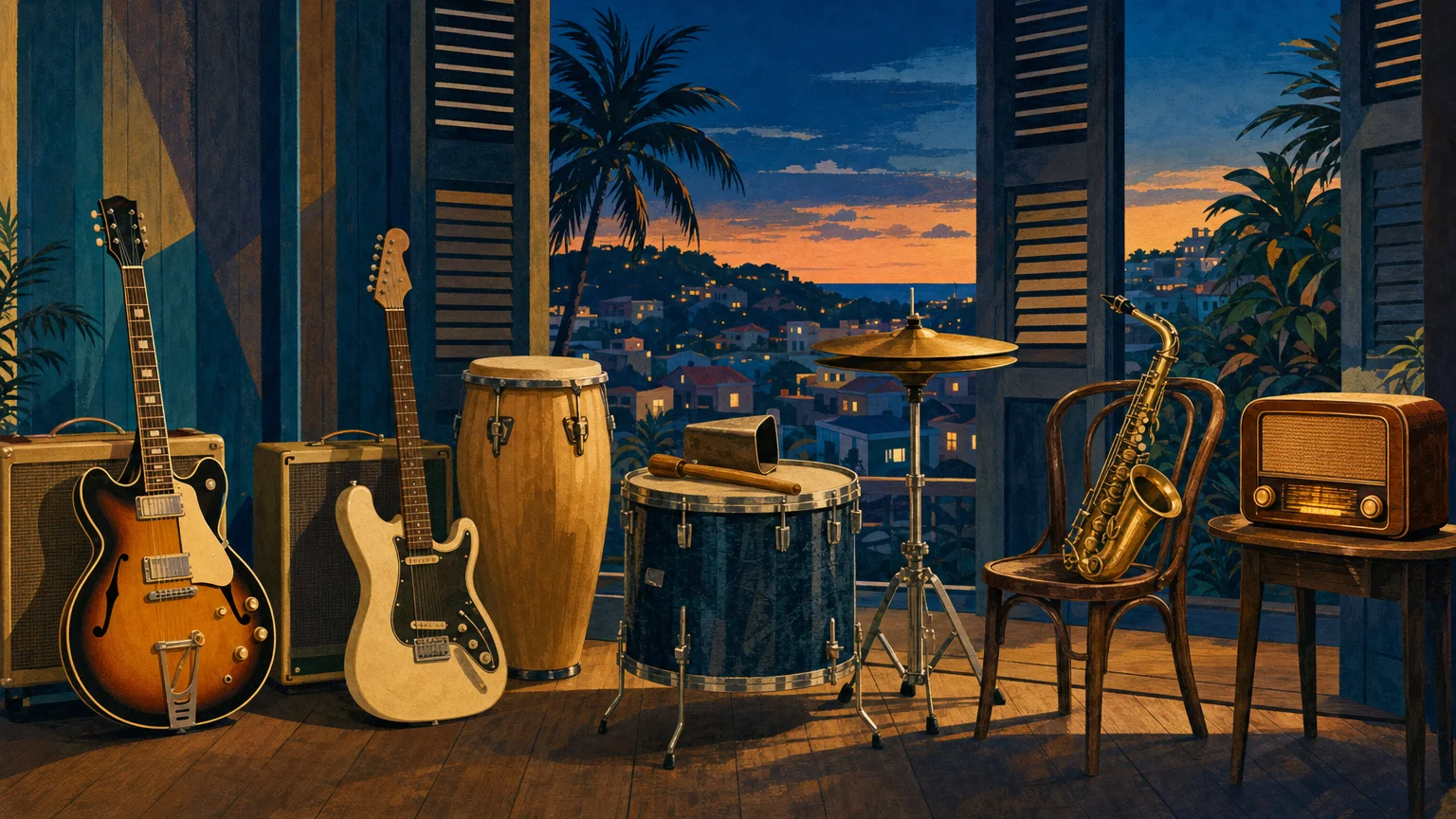
Written and fact-checked by the ZoukAfrobeat editorial team. Historical statements are sourced above and attributed in the text where the record credits more than one person. The listening note in the final section is editorial observation, labelled as such. The featured image is an AI-generated illustration created for this article; it is not a historical photograph and depicts no real band, musician or venue. No interviews were conducted for this article and no quotations are invented. See our editorial standards and corrections policy.