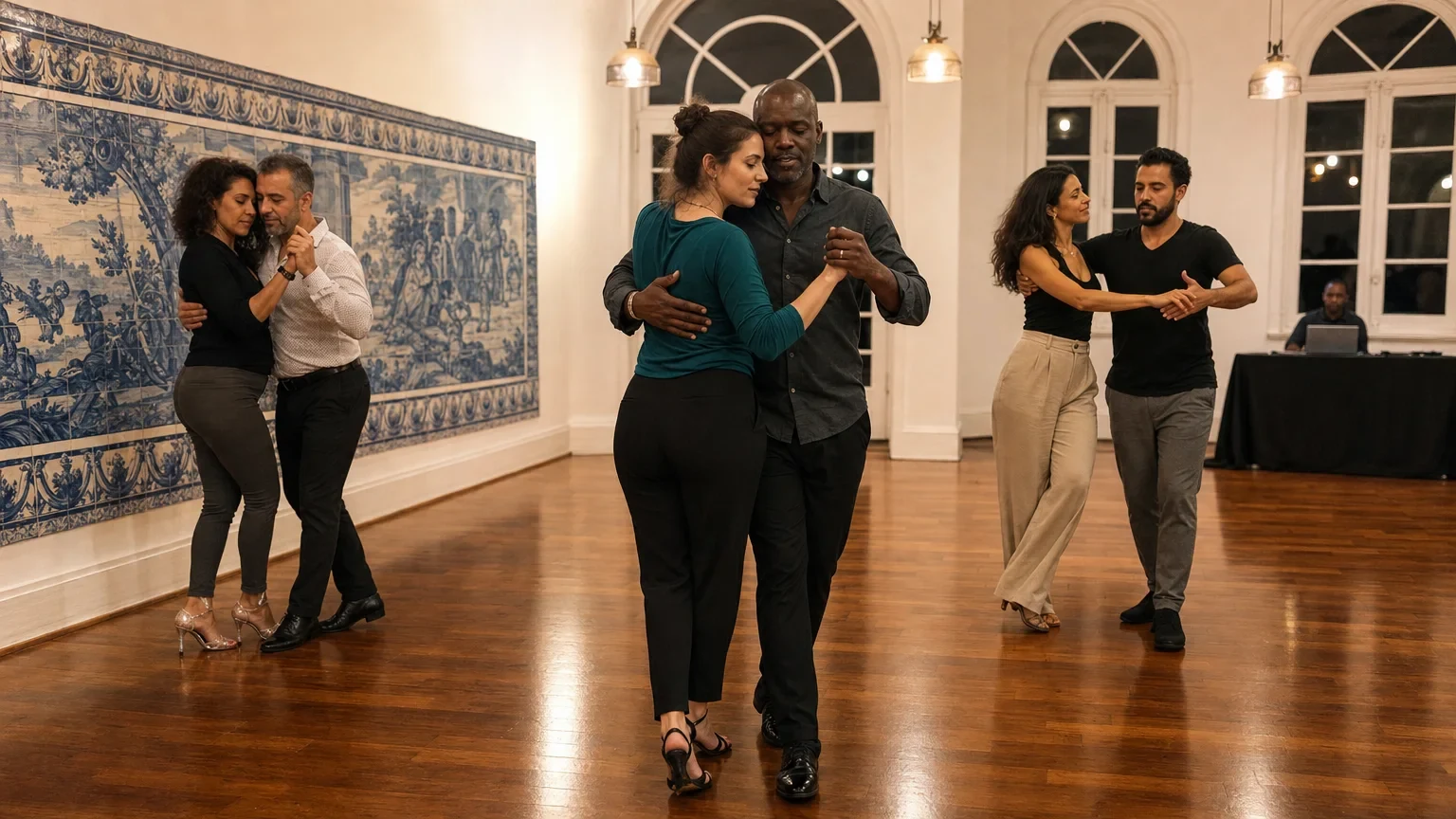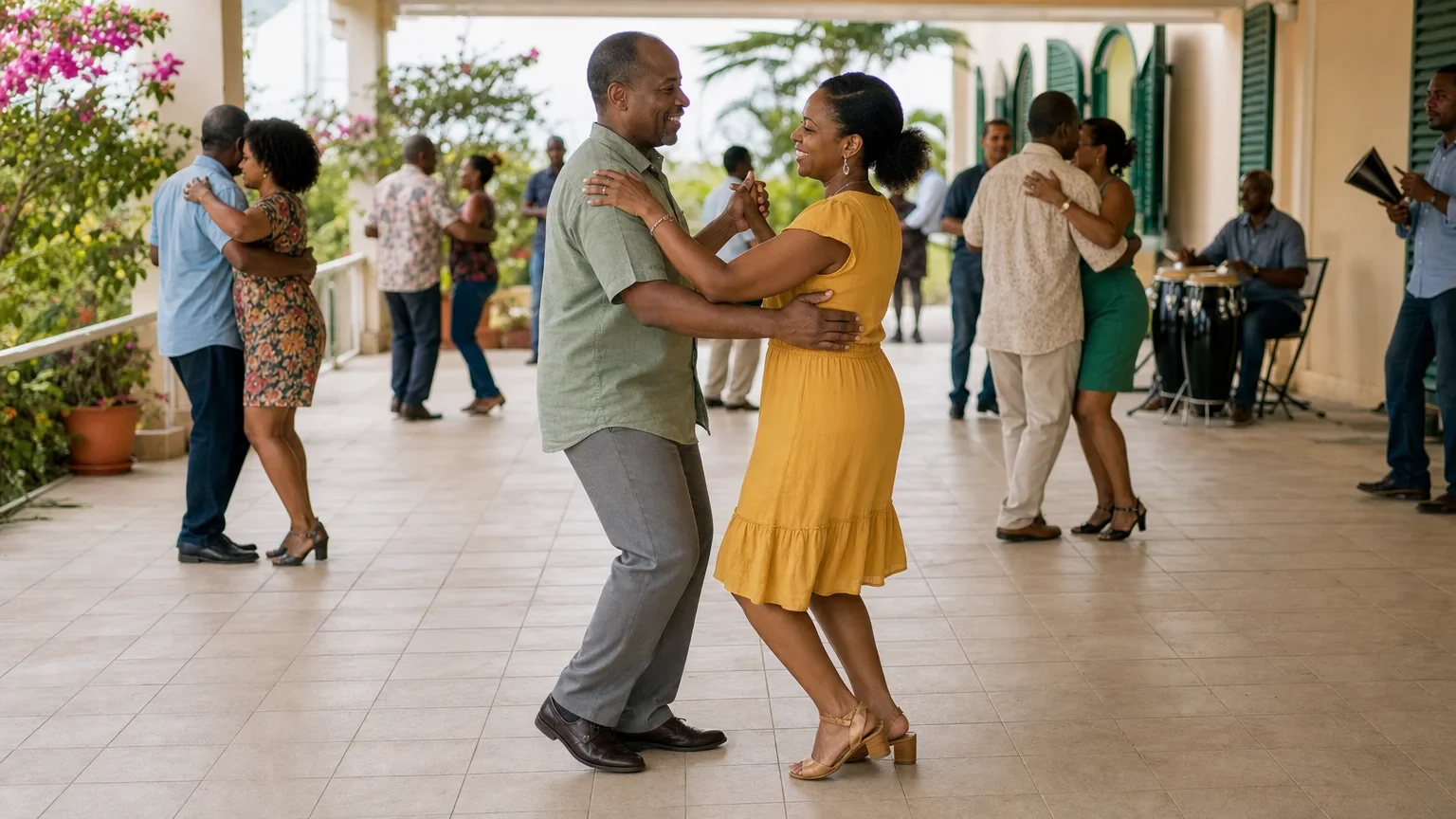
Gouyad is the close, hip-led partner dance of slow Haitian kompa — and, by extension, the slower kompa recorded for it. Partners stay connected through the torso and hips and keep footwork to a minimum, moving in a continuous rolling sway. The word comes from gouye, the Haitian Creole verb for swaying or wiggling the hips.
What gouyad actually is
Gouyad is a dance before it is a genre label. It is danced in a close embrace, and the connection runs through the chest and hips rather than through the hands. Where traditional kompa dancing keeps a recognisable step pattern and travelling footwork, gouyad compresses the movement almost to the spot and puts the emphasis on a continuous, circular motion of the waist.
UNESCO’s 2025 inscription of The Compas of Haiti describes the compas dance as a rhythmic walk marked by pelvic movement, alternating steps and a physical connection between partners. Gouyad sits at the slow, most connected end of that dance.
Because the movement asks for space and time, it favours slower records. That is how a dance name ended up attached to a body of music: when Haitian bands, DJs and remixers began building slow, extended sections specifically for this dance, “gouyad” became a useful shorthand for the records themselves.
How gouyad grew out of kompa
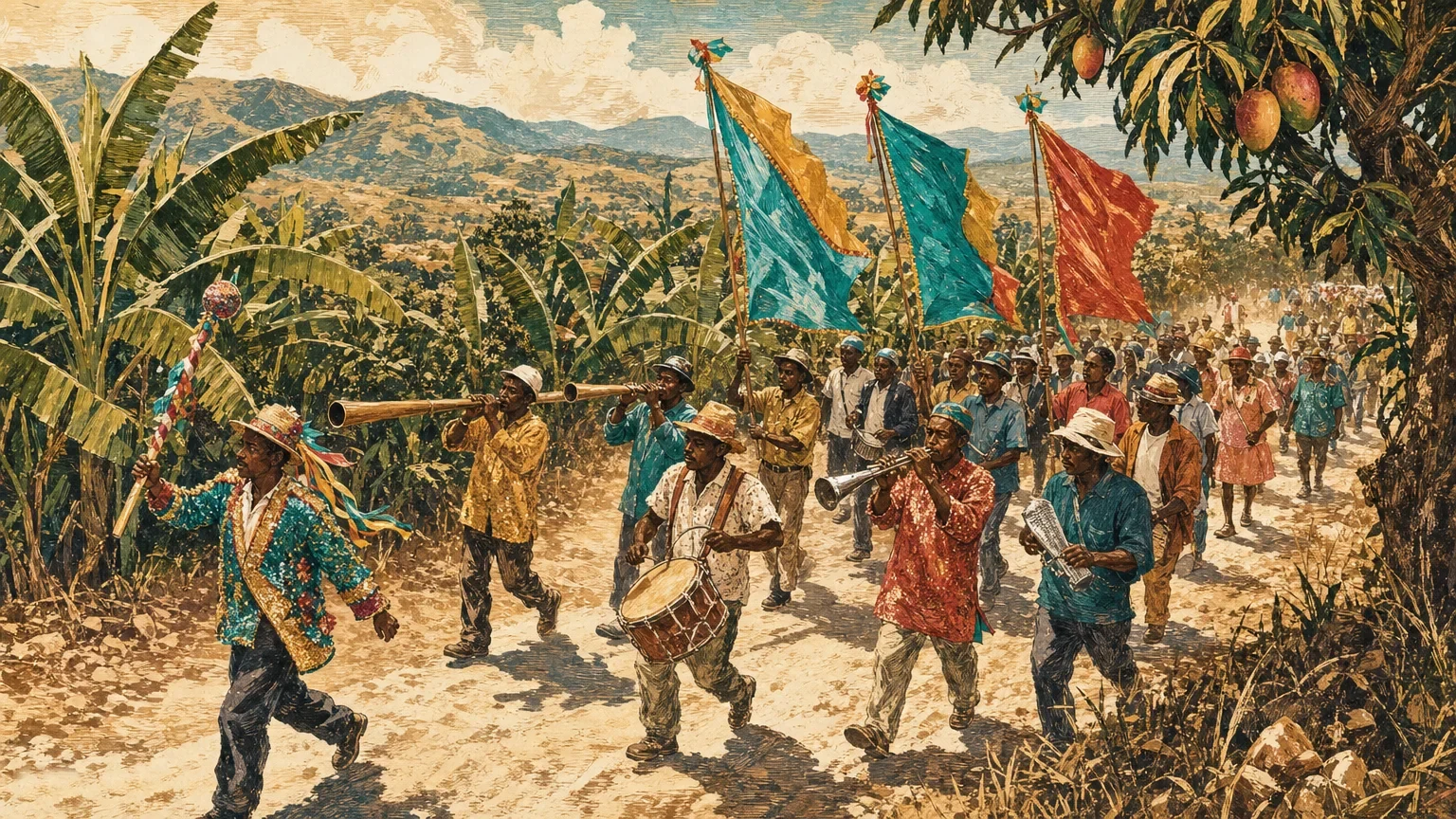
Kompa took shape in Haiti in 1955, when the saxophonist and bandleader Nemours Jean-Baptiste reworked Haitian méringue into a steadier, more insistent dance beat. Our kompa guide tells that story in full.
The hip movement goes back further than slow kompa. Writing in 1997, the ethnomusicologist Gage Averill described the gentle rolling of the hips in Haitian méringue dancing, the music kompa grew out of, and noted that in Haiti the movement was sometimes called gouyad.
Slow, romantic kompa gave dancers room for that close, circular movement. We have not found a reliable source that dates when gouyad became the name for a style of slow kompa, so we do not give one. Today the word turns up constantly in mix, playlist and DJ-set titles; in our experience programming ZoukAfrobeat mixes, that is where many new listeners first meet it.
In that sense gouyad is not a break from kompa but its slow, intimate register, named after the way people dance to it.
Not everyone in Haitian music accepts that framing. Some musicians and writers argue that keyboard-heavy commercial gouyad has drifted from konpa’s band tradition. One essay marking konpa’s seventieth anniversary states plainly that gouyad “is not Konpa”. We record that debate here rather than settle it.
What the word gouyad means
Gouyad comes from gouye, a Haitian Creole verb. The Haiti-Référence Creole dictionary defines gouye as to sway or wiggle one’s hips, and also gives broader senses — to get a move on, to stir — matching the French se déhancher and se remuer. Gouyad is the noun formed from that verb: the swaying of the hips, and by extension the dance built on it and the slow kompa played for it.
Gage Averill’s study of Haitian popular music traces gouye further back to the French grouiller, to move or stir, and records mabouya, the name of the island’s largest lizard, as another Haitian name for the same movement.
What a gouyad record sounds like
There is no official tempo specification for gouyad, and we will not invent one. What is consistent across the records that work on a gouyad floor is the feel:
- Unhurried tempo. Slow enough that a couple can hold a rolling motion without rushing it.
- Space in the arrangement. Bass and drums carry the groove; the mix leaves room rather than filling every bar.
- A steady, unbroken pulse. Abrupt tempo changes break the connection, so transitions tend to be gradual.
- Vocals in Haitian Creole or French, usually on romantic themes.
Those are editorial listening observations from programming ZoukAfrobeat mixes, not technical specifications.
Gouyad, kompa, zouk and kizomba compared
These get conflated constantly. On the dance floor the differences are clear:
- Gouyad vs kompa. Kompa is the music and the wider partner dance, from 1955. Gouyad is its slow, close, hip-led end: less travelling footwork, more continuous rolling movement. Gouyad is danced to kompa and music derived from it, but not all kompa is gouyad. For the music’s history, see what Haitian kompa is.
- Gouyad vs kizomba. Both are close partner dances to slow music, which is why they are confused. Kizomba is Angolan and grew out of semba; gouyad is Haitian and grew out of kompa.
- Gouyad vs zouk. Zouk comes from Guadeloupe and Martinique, not Haiti. Its slow romantic strain is zouk love.
The full country-by-country comparison of kompa, zouk and kizomba is in our kompa guide.
Where to start listening
The clearest way to hear the difference is to listen across the categories rather than reading about them:
- The Gouyad series — slow, floor-focused Haitian selections.
- Haitian Kompa — the parent form, across tempos.
- Zouk Love — the French Caribbean romantic lane.
- Playlists & Mixes — full curated sets.
- Lè Kè M Jwenn Limyè and Ant Lanmou ak Libète — ZoukAfrobeat’s own Kompa Gouyad albums, with track previews.
This mix is a direct example of the sound described above:
Gouyad Therapy — Creole Caribbean Music | Pi Bon ke Koupe (After Hours Vol. 4), published on the ZoukAfrobeat YouTube channel on 3 July 2026.
Common questions
What does gouyad mean?
It names the close, hip-led Haitian partner dance and, by extension, the slow kompa played for it. The word comes from the Haitian Creole verb gouye, to sway or wiggle the hips.
Is gouyad a genre or a dance?
Primarily a dance. The word is also used for the slower kompa records made and selected for that dance, which is why it appears as a music category on streaming services and mix titles.
Is gouyad the same as kompa?
No. Gouyad sits inside Haitian kompa culture: it is danced to kompa and music derived from it, but not all kompa is gouyad. Some Haitian musicians draw a firmer line between the two; see how gouyad grew out of kompa.
Is gouyad the same as kizomba?
No. Both are close partner dances to slow music, which is why they are confused, but gouyad is Haitian and grows out of kompa, while kizomba is Angolan and grows out of semba.
What language are gouyad songs in?
Most often Haitian Creole, frequently French, and sometimes a mix of both.
Do I need a partner to learn gouyad?
The dance is built around a close two-person connection, so partner practice is how it is normally learned, though the hip movement itself can be practised alone.
Sources
Historical claims on this page draw on the following published references:
- Haiti-Référence Creole dictionary: gouye — the meanings of the verb gouye. Verified 2026-10-05.
- Gage Averill, A Day for the Hunter, a Day for the Prey: Popular Music and Power in Haiti (University of Chicago Press, 1997) — gouyad and mabouya as Haitian names for the hip movement in méringue dancing, and the derivation of gouye.
- UNESCO Intangible Cultural Heritage: The Compas of Haiti — the 2025 inscription and UNESCO’s description of the compas dance. Verified 2026-10-05.
- Nemours Jean-Baptiste — attribution of konpa and the 1955 founding.
- Compas — kompa’s roots in Haitian méringue.
- Konpa is turning 70: Haitian Music’s past, present and future (2025) — a critical Haitian view of commercial, keyboard-led gouyad.
- Kassav’ — zouk’s French Antillean origin and the Guadeloupean and Martinican rhythms it drew on.
- Kizomba — kizomba’s Angolan origin and its roots in semba.
Written and fact-checked by the ZoukAfrobeat editorial team. Historical statements are sourced above; tempo and arrangement observations are editorial opinion formed while programming ZoukAfrobeat mixes, and are labelled as such. Where a translation or etymology is contested, we say so rather than choosing one. Automation assists production at ZoukAfrobeat; factual claims are verified before publication. See our editorial standards and corrections policy.