Rara is Haiti’s Lenten street-procession music: bands of drummers, singers and players of single-note bamboo trumpets called vaksin who parade through towns and countryside in the weeks before Easter, with deep roots in Vodou. It did not create kompa, whose documented origins lie in 1950s dance bands and Dominican merengue. But rara’s rhythms, its hocketing trumpets and its sharp-tongued songs have crossed into Haitian popular music again and again, most of all in the mizik rasin (roots music) of the 1980s and 1990s.
What rara is
The ethnomusicologist Gage Averill describes rara as a processional music of Haiti’s peasants and urban lower classes. The folklorist Michael Largey calls it a Haitian Lenten festival of exuberant dancing and singing with strong connections to Vodou, and argues that it gives lower-class Haitians a space to speak about history and politics. Both descriptions matter. Rara is music, but it is also a festival, a religious obligation and a public forum, all moving down the road at once.
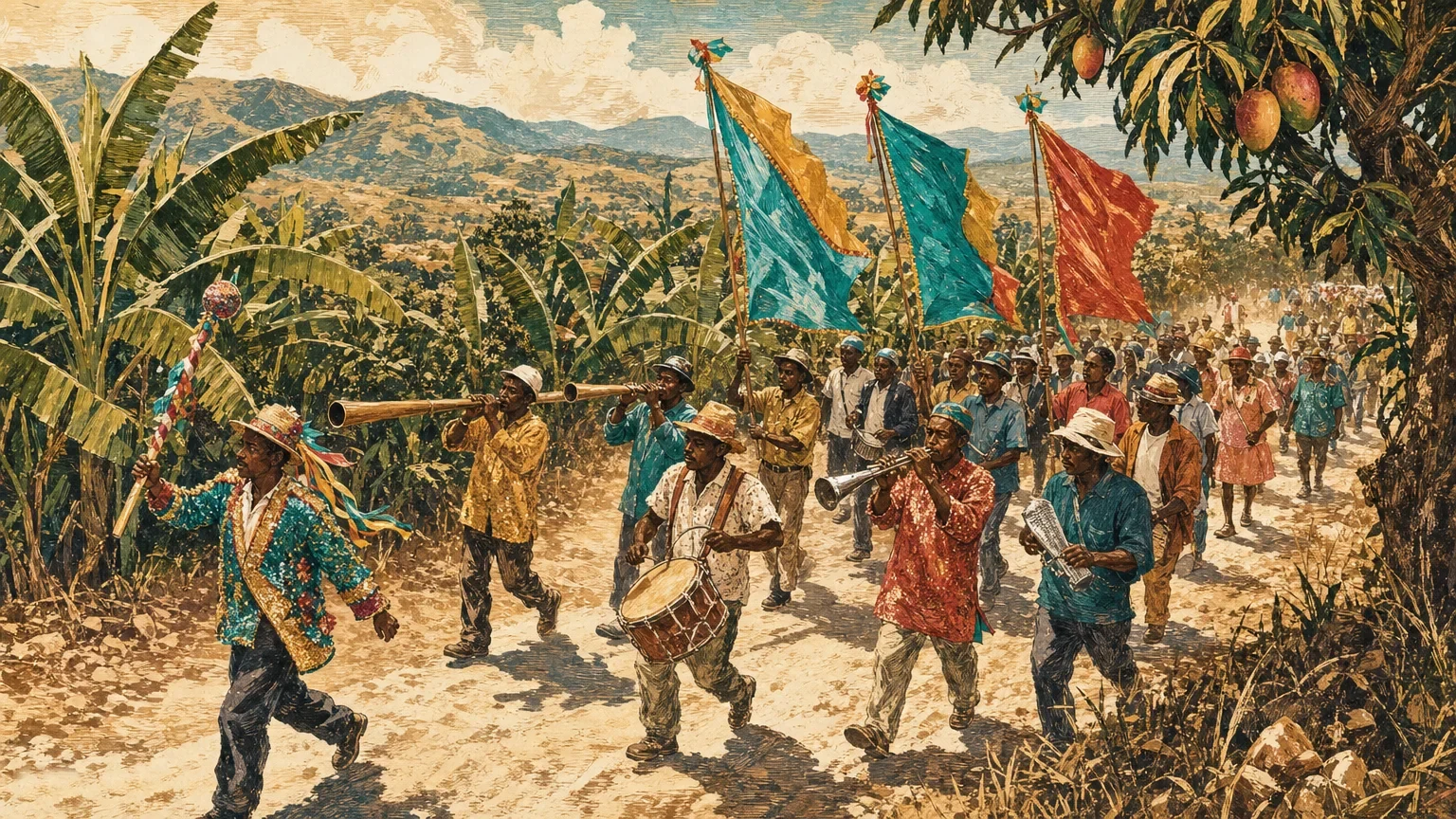
A rara band on the march is a loose, loud, mobile community: musicians, singers, dancers, flag bearers and a crowd that joins and drops away as the procession passes. Its sound is unlike anything played on a Haitian dance-band stage, and that difference is the key to understanding both what rara has given popular music and what it has kept for itself.
A season, not a stage show
Rara belongs to the calendar. Elizabeth McAlister, whose book Rara! Vodou, Power, and Performance in Haiti and Its Diaspora (2002) is the standard study, writes in the notes to the Smithsonian Folkways album Rhythms of Rapture that bands parade during Lent, from Ash Wednesday until Easter. On her research website she adds that rara activity can begin as early as 6 January, Epiphany, overlapping with carnival, before continuing through Lent. The music scholar Lois Wilcken describes bands marching on the Sundays after Ash Wednesday and building towards a festival in Easter Week.
The dates vary by region and by band, so the safest summary is the one Averill gives: rara season is roughly Lent, and it peaks in Holy Week. Wilcken links that timing to the French colonial period, when colonial law gave enslaved people time off during Holy Week. During the season, she notes, bands can be heard at night across much of the country.
Rara as spiritual work
McAlister describes rara as carnival-like “play” wrapped around serious religious “work”. The core of many bands is made up of leaders of Vodou societies who are fulfilling ritual obligations to the lwa, the spirits. A band may be formed because a spirit asked for it. Before going out, members prepare and “heat up” their instruments; on the road they salute sacred places such as ancestors’ graves, trees, rocks and crossroads. Some bands, she reports, even go to cemeteries to ask permission to bring the spirits of the recently dead into the procession.
That religious core is why McAlister insists that, unlike many other Afro-Creole parade traditions, rara is explicitly religious. One of her own field recordings on Rhythms of Rapture captures the band Rara Ya Sezi at a Vodou compound, the lakou Kanno in Verrettes in the Artibonite, on Easter Sunday 1993. Not every band is equally devout, and urban and diaspora bands can lean more towards carnival, so it is best not to generalise in either direction.
How a rara band is organised
Rara bands borrow the language of armies. McAlister lists presidents, colonels, majors and captains among their ranks and describes bands as competing “armies” on manoeuvres, sometimes in rivalry with other bands in the same area. She suggests the ranks may echo eighteenth-century peasant armies that marched with music, a hypothesis rather than a settled fact.
On the road, the colonel leads from the front with a whistle and a whip. Behind come the drums, the bamboo trumpets, metal horns and other percussion in battalion-like waves, followed by the chorus. Featured dancers, among them the baton-twirling majò jon and the band’s kings and queens, perform in exchange for contributions from onlookers.
Vaksin, horns and drums: the rara sound
Hocketing bamboo
The signature instrument is the vaksin (also called banbou): a length of hollowed bamboo blown like a trumpet, with longer tubes giving lower notes. Each instrument plays a single note. A melody only appears when several players blow in turn, each sounding their note at the right moment, a technique known as hocketing. McAlister explains that players improvise together until they settle on a short, catchy riff, and keep time by beating a rhythm called kata on the bamboo with a stick, so the instrument is melodic and percussive at once. Wilcken compares the way the vaksin pass motifs around to some vocal styles of Central Africa.
Deliberate dissonance
Wilcken points out that the characteristic augmented fourth of the vaksin scale clashes with the key of the songs, giving rara a feeling of dissonant polytonality. To ears trained on dance-band harmony it can sound “out of tune”. It is not: the clash is the sound.
Horns and percussion
Beside the bamboo, bands use short horns of pressed tin, spelled variously konè, konet or kòné in the scholarly literature, along with goatskin drums, rattles (tchatcha) and metal scrapers (graj). Wilcken notes that rara and carnival bands share this kind of drum and percussion ensemble resting on a kata foundation. Some bands, especially around Léogâne, go further: McAlister reports that they win national reputations by hiring brass players from kompa bands.
Songs as news, mockery and protest
Rara songs mix the sacred, the vulgar and the political, often in the same afternoon. Averill describes the chan pwen, the “pointed song” of veiled criticism that rarely names its target, as common to Vodou and rara processions. McAlister documents how coded language works on the road: during her fieldwork, downtown street culture used “Babylon”, borrowed from Rastafari, to mean the military. She argues that rara creates a “semiautonomous stage for discourse” for people who otherwise have little public voice.
Politicians noticed. Averill reports that in the run-up to Haiti’s 1990 elections many candidates used rara-style radio jingles to reach rural voters, and the electoral authorities themselves explained the vote in a rara-style song, “Sèz desanm” (“Sixteenth of December”).
Rara and carnival
Rara and carnival (kanaval) are neighbours, not twins. Carnival bands, Wilcken explains, march from the first Sunday after Epiphany to Mardi Gras, and carnival songs share rara’s biting commentary and risqué lyrics. Averill notes that Haitian méringue has its own carnival form, the méringue de carnaval. From the early 1960s, the big dance bands joined in: the rival orchestras of Nemours Jean-Baptiste and Webert Sicot played on floats and trucks, their amplified sound drowning out the acoustic street bands, and later the mini-djaz took over the floats.
The difference is one of purpose and season. Carnival is a pre-Lenten festival that, in Port-au-Prince, came to be dominated by commercial bands on trucks with huge speakers. Rara begins where carnival ends, walks rather than rides, and carries religious obligations that carnival does not.
Where rara meets popular music
The documented crossings between rara and Haiti’s popular music are specific, and worth stating precisely.
- A 1962 big-band arrangement. Averill highlights “Coté Moune Yo?” (“Where are those people?”), recorded by Super Jazz des Jeunes for Ibo Records in 1962: an arrangement of a song usually sung by rara bands, mixing single-note bamboo trumpets with big-band instruments.
- A drum pattern in the mini-djaz. When the small electric bands of the 1960s and 1970s rebuilt kompa around a drum kit, Averill writes, the very strict five-note rhythm played on the hi-hat was based on the traditional kata rhythm, and is credited to Herman Nau of Tabou Combo. Kata is not exclusive to rara (Wilcken also places it in carnival and Vodou drumming), so this is a shared rhythmic element, not proof that kompa came from rara.
- Influence running the other way. As McAlister notes, some Léogâne rara bands hire brass players from kompa bands. Popular music has shaped rara too.
- A song about rara. In 1985 the singer-songwriter Beethova Obas wrote “Plezi mizè” (“The pleasures of poverty”), which Averill describes as an underground hit during the hunger riots of that year, portraying rara festivities as a respite from rural hardship.
Mizik rasin: rara in the roots movement
The deepest crossing came with mizik rasin. Averill explains that “rasin” (roots) referred to the music of Vodou ceremonies and of the Lenten processions called rara. In the early 1980s, a circle of musicians around Louis Lesley Marcelin, known as Sanba Zao, laid the foundations of what was first called the sanba movement, taking their name from sanba, the traditional term for a rara singer and composer. They visited the great Vodou lakou of the Artibonite, such as Soukri, Souvenance and Badjo, to learn the music at its source.
The group Groupe Sa Mizik first played in public in 1982 at the Rex Théâtre in Port-au-Prince; two years later it split into the jazz-roots band Foula and the more traditional Sanba-yo, whose “Vaksiné”, written for a 1986 UNESCO vaccination campaign, became the first widely broadcast rasin track. Boukman Eksperyans won national attention in 1989 by taking the third Konkou Mizik music contest with the rara-rock song “Pran Chenn, Wèt Chenn”, and its 1990 carnival song “Kè m pa sote” (“I am not afraid”) became a rallying cry against the military government of General Prosper Avril. In 1992 the band RAM built its carnival song “Anbago” around a line from the same old rara chant, “Kote moun yo?”, that Jazz des Jeunes had arranged thirty years earlier.
Wilcken identifies exactly what made rasin sound different from other modern styles: the sound of rara. Beyond the ever-present kata rhythm, synthesizers reproduce the “dissonance” of vaksin ensembles at key moments, and in concert rasin bands use cordless microphones to recreate the motion and commotion of a procession.
What rara did not do, and what stays distinct
It is tempting to tell a tidy story in which rara gave birth to Haitian dance music. The sources do not support it. In Averill’s detailed history, kompa begins in 1955 with Nemours Jean-Baptiste’s dance orchestra in Port-au-Prince, during a craze for Dominican merengue, with a drum pattern adapted from merengue. Rara is not part of that origin story. For the full account, read our guide to what kompa is.
And even where they meet, the two remain different kinds of music. Rara is seasonal, outdoor and processional, tied to the Lenten calendar and, for many bands, to spiritual obligations. Its melodies are built from single notes passed between players, and its dissonance against the songs is deliberate. Kompa and other dance-band styles are played on stages, floats and records all year, organised around chords and arrangements; even rasin, Wilcken observes, adds European chord types and functional harmony on guitars and keyboards. What popular musicians have borrowed from rara is a set of sounds, rhythms, songs and a spirit of commentary, not the procession itself.
Rara beyond Haiti
Rara travelled with Haitian migrants. McAlister describes summer Sundays in the 1990s when hundreds of Haitians gathered in Brooklyn’s Prospect Park, following young men playing drums and bamboo tubes, and she places rara in dialogue with Haitian dancehall and hip-hop in the United States. Its recorded history goes back further: according to the Association for Cultural Equity, Alan Lomax’s 1936–37 recordings in Haiti for the Library of Congress, some seventy hours of music, document early rara.
Where to start listening (editorial suggestion): McAlister’s field recordings on Rhythms of Rapture (Smithsonian Folkways, 1995) give the sound of bamboo, voices and drums on the road. Put them next to Boukman Eksperyans and RAM and you can hear exactly which pieces of rara the roots bands carried onto the stage.
Common questions
Is rara a Vodou ceremony?
Rara is closely tied to Vodou and, for many bands, involves real ritual obligations to the spirits, but it is also a public festival with dancing, comedy and politics. McAlister describes it as religious “work” inside carnival-style “play”.
When does rara take place?
Chiefly during Lent, peaking in Holy Week and Easter. Some activity starts as early as Epiphany, and exact dates vary by region and band.
Did rara create kompa?
No. Kompa’s documented origins are in 1950s Port-au-Prince dance bands and Dominican merengue. Rara has contributed specific elements to Haitian popular music, including songs, the kata-based rhythm that shaped the mini-djaz hi-hat, and much of the sound of mizik rasin.
What instruments are used in rara?
Single-note bamboo trumpets (vaksin or banbou), tin horns (konè), goatskin drums, rattles and metal scrapers, and in some bands, brass instruments.
Sources
Historical and ethnographic statements in this article are drawn from the following. Laméca publishes its dossiers over plain HTTP only.
- Elizabeth McAlister, Rara! Vodou, Power, and Performance in Haiti and Its Diaspora (University of California Press, 2002), and its companion website at Wesleyan University: “Rara as a religious obligation in Vodou”, “Rara as a form of carnival”, “Rara and politics”, “The music and dance of Rara” and “Rara in New York”.
- Rhythms of Rapture: Sacred Musics of Haitian Vodou, Smithsonian Folkways SF 40464 (1995), liner notes. The Lenten season, hocketing and the 1993 recording of Rara Ya Sezi.
- Lois Wilcken, “Vodou music in Haiti”, part 5: “Work and celebrate: the konbit, carnival and rara” and part 6: “Vodou music in neo-traditional contexts”, Médiathèque Caraïbe (Laméca).
- Gage Averill, Konpa ! La musique populaire en Haïti, Laméca: chapter 1 (Jazz des Jeunes, méringue), chapter 4 (kompa’s origins, chan pwen, carnival), chapter 5 (the kata-based hi-hat) and chapter 6 (mizik rasin, Boukman Eksperyans, RAM).
- Gage Averill, “Recherche sur le pouvoir dans la musique caribéenne : le cas d’Haïti, 1985-1995”, Laméca. “Plezi mizè”, the 1990 election songs and RAM’s “Anbago”.
- Gage Averill, A Day for the Hunter, a Day for the Prey: Popular Music and Power in Haiti (University of Chicago Press, 1997), published excerpt.
- Michael Largey, “Politics on the Pavement: Haitian Rara as a Traditionalizing Process”, Journal of American Folklore 113, no. 449 (2000): 239–254. Abstract consulted.
- Association for Cultural Equity, Alan Lomax biography. The 1936–37 Haiti recordings.
Written and fact-checked by the ZoukAfrobeat editorial team. Statements are attributed in the text to the scholars who made them; where sources disagree, as on the exact start of the rara season, both versions are given. The listening suggestion is editorial. No song lyrics are reproduced, no interviews were conducted and no quotations are invented. The featured image is an AI-generated illustration created for this article; it is not a photograph and depicts no real band, procession or place. See our editorial standards and corrections policy.