Nemours Jean-Baptiste and Webert Sicot were Haitian saxophonists and bandleaders who began as bandmates and became the great rivals of Haitian dance music from the late 1950s to the late 1960s. Nemours led the orchestra credited with launching compas direct (konpa dirèk) in 1955; Sicot answered around the turn of the decade with a closely related style he called cadence rampa. Their feud, fought in songs, at carnival and once on a football pitch, sold records, split the country into two camps and set a pattern of band rivalries that Haitian music still follows.
Two saxophonists, the same bandstands
Long before they were rivals, Nemours Jean-Baptiste and Webert Sicot were colleagues in the same small world of Port-au-Prince dance orchestras. According to the ethnomusicologist Gage Averill, whose history of Haitian popular music is the most detailed account available, Nemours was born into a middle-class Port-au-Prince family on 2 February 1918. He learned guitar and banjo, then saxophone, and in the early 1940s played with Jazz Guignard and the Conjunto International, where he met the man Averill calls his future partner and rival.
Sicot came up through Le Jazz Capois alongside his brother Raymond, a trumpeter, and played in many of the leading orchestras of the late 1940s and 1950s: the Conjunto International, the Orchestre Atomique, the Ensemble de la Cabane Choucoune and, crucially, Nemours’s own Ensemble Aux Calebasses. Averill describes Sicot as probably the most important Haitian saxophonist of his era. Whatever happened later, the two men learned their trade on the same bandstands.
1955: a beat with more than one author
The music that made Nemours famous grew out of a specific moment. In the mid-1950s, Averill writes, Port-au-Prince had a thriving scene in hotels and nightclubs, spread across the country by radio. Next door, Dominican merengue was enjoying enormous popularity, helped by the backing of President Rafael Trujillo and by Dominican radio stations audible in Haiti. Averill dates the real arrival of the merengue wave to a 1954 Haitian tour by the accordionist Angel Viloria and his Típico Cibaeño.
Haiti celebrates the birth of compas direct on 26 July 1955. Le Nouvelliste, marking the seventieth anniversary in 2025, describes a band born that night in front of Chez Maggy on Sainte-Anne Square, the Conjunto International, as the first version of what became the Ensemble Nemours Jean-Baptiste, and lists Webert Sicot among the musicians who played. Averill’s account differs in its details: he has Nemours founding his own orchestra at the club Aux Calebasses in 1953 and launching his new, Dominican-influenced dance in the summer of 1955 at the club Aux Palmistes, where he led the house band. Published histories also disagree about what the band was called in those first years.
The story is collective in other ways too. Averill credits the name compas direct, a commercial label meaning roughly a straight, square beat, to Nemours’s guitarist Raymond Gaspard. Accounts of the band’s sound credit players such as the accordionist Richard Duroseau and the drummer Kreutzer Duroseau. Frantz Duval, editor of Le Nouvelliste, adds a useful caution: in 1955 the rhythm was not yet fully defined and took years to settle, and Nemours’s small band was far from the most prominent in a city still ruled by Jazz des Jeunes. When UNESCO inscribed the compas of Haiti on its list of intangible cultural heritage in 2025, its decision credited the practising communities, not any one inventor. Nemours’s role as bandleader and figurehead is not in doubt; the idea that he invented the music alone is not supported by the sources. For the wider story of the genre, see our guide to what kompa is.
What compas direct sounded like
Averill describes the new music’s “square” pulse, reinforced by a one-two pattern in the bass, with the drum playing a variant of the merengue rhythm traditionally beaten on the Dominican tambora. The accordion played chords, arpeggios and some melody, while saxophones and trumpets answered with the main tunes. Afropop Worldwide adds that, besides merengue, the style drew on Cuban son and charanga and on American big-band swing.
Averill calls compas direct the first Haitian music to develop in a fully commercial environment, and it was attacked for exactly that. Cultural nationalists objected to its popular appeal, its Dominican influence and what they saw as commercial novelty. The first great musical quarrel of the compas era was in fact not with Sicot at all, but with Jazz des Jeunes, then Haiti’s leading orchestra, which mocked Nemours’s band in a series of insulting songs. Averill treats them as chan pwen, pointed songs of veiled criticism that Haitians also know from Vodou and rara.
The quarrel did not stop compas. Averill notes that Nemours played different rooms for different audiences: urban teenagers on Fridays, the elite at Cabane Choucoune in Pétion-Ville on Saturdays, the middle classes on Sundays, the popular classes at carnival, and provincial patron-saint festivals. In 1958, he writes, the band was renamed the Ensemble Nemours Jean-Baptiste, and by then compas direct was the most popular style in Haiti.
Sicot’s answer: cadence rampa
At some point Sicot left Nemours’s orbit and launched his own band and his own beat. The date is disputed: Averill places the founding of the Ensemble Webert Sicot around 1959, while Afropop Worldwide dates his new style to the early 1960s. Sicot called it cadence rempa; according to Averill, the record producer Joe Anson of the Ibo label rendered it in Creole as kadans-ranpa. Averill glosses kadans as rhythm and ranpa as ramparts, a nod to the warlike relations between the two camps. In print, the name appears as rempa, rampa, rampas and ranpa. Sicot’s band also took a grand nickname, La Flèche d’Or d’Haïti, “the golden arrow of Haiti”, seen on its 1967 album cover.
How different were the two styles?
Less than the rivalry suggested. Averill’s verdict is that Sicot’s new rhythm was barely distinguishable from Nemours’s compas direct. Other sources point to differences of emphasis: the Haitian Times describes cadence rampa as slightly faster, and Afropop says it leaned further into Cuban son and American jazz. A music review of Strut’s Cadence Revolution compilation adds that Sicot began calling his music “cadence” precisely to distinguish it from compas.
Put together, the evidence suggests two versions of the same modern Haitian méringue-derived dance music, separated more by branding, arrangement and the personalities of two star saxophonists than by any basic difference of rhythm. That is not a criticism. In a commercial market, a name and a sound you could tell apart from your rival’s were exactly what a band needed.
A listening suggestion (editorial): compare Nemours’s “Ti Carole”, which Afropop singles out for its big-band horns and intimate accordion solo, with one of Sicot’s carnival recordings such as “Bon Jan Van” (1967), which opens with a long saxophone solo. Listen for the tempo, the role of the saxophone and the density of the arrangement rather than for a different beat.
The épòk polemik
Averill reports that the late 1950s to late 1960s became known as the epòk Nemou ak Siko or epòk polemik, the era of Nemours and Sicot, or simply the era of polemics. The two bands copied each other, insulted each other, tried to outdo each other and, he writes, sometimes went as far as stealing each other’s equipment.
Much of the fight was conducted in song. Nemours answered his critics with “Rythme commercial”, built on a Haitian proverb: people only throw stones at the mango tree that is full of fruit. Sicot, widely regarded as the stronger instrumentalist, replied with “Deux guidons”, mocking his rival’s saxophone playing and suggesting that others had to take his solos for him. In 1964, according to Averill, the two bands even met in a football match at the Stade Sylvio Cator in front of 35,000 fans. It ended 1–1, and each band then recorded its own version of the result.
How bitter was it? Accounts differ in tone. Writing in The Beat in 1987, CC Smith and Gerard Tacite Lamothe called it a “friendly rivalry”, comparing it to the duel between the Congolese bandleaders Franco and Tabu Ley Rochereau, with fans attached to their band like football supporters. Averill’s description is harsher, yet he also reports that both leaders later acknowledged that the polemic worked as marketing, deepening their fans’ loyalty. The best reading is both: a contest that was partly staged and highly profitable, but with real heat among the people who took sides. For how the young mini-djaz bands eventually overtook both men, see our history of the mini-djaz revolution.
Carnival, colours and the Duvalier state
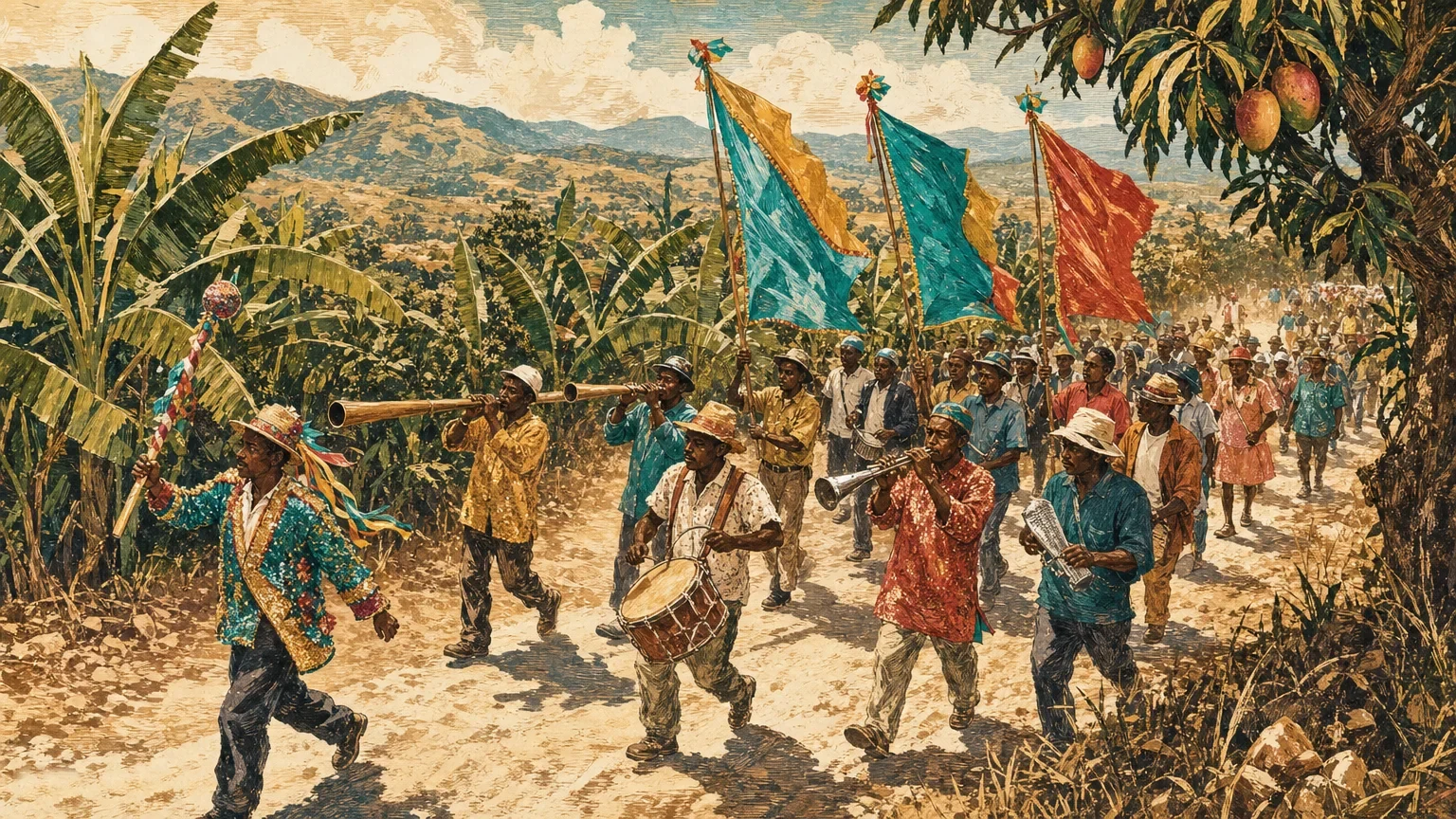
Carnival turned the rivalry into street politics. Averill describes how, at the carnivals of the early 1960s, the two bands played on floats and trucks with powerful amplification that drowned out the acoustic street bands, while fans gathered around their favourites, identifiable by the colours they wore. Nemours’s band wore red and white, celebrated in its song “Dé Koulè” (“Two colours”). Supporters clashed regularly.
The feud also reached into the regime of François Duvalier. Averill reports that even the Tonton Macoutes militia was divided, wearing one band’s colours or the other’s over their uniforms, with each parade led by prominent members; that Duvalier’s son Jean-Claude favoured Sicot’s cadence while his daughter Denise favoured Nemours’s compas; and that both bands recorded songs in praise of the government and were hired, or pressed, to play at koudyay, the state-organised street celebrations Duvalier used to project popular support. These are Averill’s findings, and they are a reminder that Haiti’s most popular music of the period was never far from power.
Cadence crosses the water
Sicot’s name travelled further than his rival’s in one important direction. The Strut review notes that, after Webert and Raymond Sicot spent time in the French Antilles, cadence became the most popular dance music there by the early 1970s. Dominica’s Division of Culture, in its history of the island’s contemporary music, describes cadence-lypso, created in the 1970s by the band Exile One, as a fusion of Haitian compas or cadence rempa with Trinidadian calypso. The precise dates of the Sicot brothers’ visits to Martinique and Guadeloupe are not well documented, so they are not given here.
The end of an era, and a late embrace
By Averill’s account, the two orchestras’ dominance ended around 1967–68, as smaller, younger bands won over the young audience. It was Nemours himself, Averill notes, who gave those bands their name: mini-djaz.
The rivals’ later years were not prosperous. Averill writes that by the 1980s the modest circumstances of both men prompted a movement among Haitian musicians and fans, later called l’accolade (“the embrace”), to honour older musicians, respect the history of the music and end the habit of musical polemics. In 1977 Fred Paul’s Mini All-Stars released an album drawing on Sicot’s music; in 1980 Tabou Combo recorded a tribute to Nemours. That same year an event in New York marked the twenty-fifth anniversary of compas direct, brought Nemours from Haiti to play with members of Skah Shah and raised money to buy him a new saxophone. He died, Averill notes, not long afterwards.
Why the rivalry still matters
Averill observes that the musical duels of this period shaped Haitian popular music for decades, producing pair after pair of rival bands. The structure the two saxophonists built, a recognisable house sound, devoted fan camps, song-by-song exchanges and carnival as the annual battleground, became part of how Haitian popular music works.
The rivalry also explains a puzzle for newcomers: why there are two names, compas and cadence, for music that sounds so similar. The answer is less musicology than history. Two brilliant musicians from the same bandstands needed to tell their audiences apart, and their audiences were happy to choose.
Common questions
Who invented kompa, Nemours or Sicot?
Kompa’s anniversary is dated to Nemours Jean-Baptiste’s band in July 1955, and Nemours is its acknowledged figurehead. But Sicot played in his bands in the early years, Averill credits guitarist Raymond Gaspard with the name compas direct, and other musicians helped shape the sound. Sicot later developed cadence rampa as a rival style.
What is cadence rampa?
The dance music Webert Sicot launched with his own ensemble around the turn of the 1960s, closely related to compas direct. Averill describes it as barely distinguishable; other sources mention a slightly faster tempo and more Cuban and jazz influence.
Were Nemours and Sicot really enemies?
They were fierce public rivals, trading insult songs and competing for fans, but both later admitted the polemic was good for business, and some writers describe it as a friendly rivalry.
Why is kompa’s birthday 26 July?
Haiti commemorates the night of 26 July 1955 as the birth of compas direct, the date of a performance by Nemours’s band. Averill’s history gives slightly different details of the band’s early years.
Sources
Historical claims in this article draw on the following published references. Laméca publishes its dossier over plain HTTP only. Song lyrics are paraphrased, not reproduced.
- Gage Averill, Konpa ! La musique populaire en Haïti, chapter 4: “Les origines du konpa et de la kadans”, Médiathèque Caraïbe (Laméca), Conseil Départemental de la Guadeloupe, 2016–2019. The main source for both men’s careers, the Dominican context, the polemic songs, the football match, carnival, the Duvalier period and l’accolade.
- Gage Averill, chapter 5: “Mini-djaz et migration”, Laméca. Nemours and the term mini-djaz.
- Claudel Victor, “70 Years of Compas Direct: Nemours Jean-Baptiste, the Pioneer”, Le Nouvelliste, 22 July 2025. The 26 July 1955 performance and its musicians.
- Frantz Duval, “Compas Direct’s Spread Was Slow and Steady, Like a Drip”, Le Nouvelliste, 23 July 2025.
- Juhakenson Blaise, “Haiti celebrates the 69th anniversary of Konpa music amid plea for universal recognition”, The Haitian Times, 26 July 2024.
- CC Smith and Gerard Tacite Lamothe, “Haiti 101: Legends of Haitian Music, Part One”, first published in The Beat (1987), Best of The Beat on Afropop, Afropop Worldwide.
- Morgan Greenstreet, “Haiti Direct”, Afropop Worldwide, 2014. Influences on compas and on cadence rampa.
- UNESCO Intangible Cultural Heritage, Decision 20.COM 7.B.22: The Compas of Haiti, 2025.
- Dominica Division of Culture, “Contemporary Music in Dominica, 1950–2000” (archived copy; the original page is no longer online). Cadence-lypso and Exile One.
- Rebelbase, review of Disques Debs International Vol. 2: Cadence Revolution 1973–1981 (Strut), 2020. Sicot, the name “cadence” and its spread in the French Antilles.
- Further reading: Gage Averill, A Day for the Hunter, a Day for the Prey: Popular Music and Power in Haiti (University of Chicago Press, 1997), and Jocelyne Guilbault, Zouk: World Music in the West Indies (University of Chicago Press, 1993). Neither was consulted directly for this article.
Written and fact-checked by the ZoukAfrobeat editorial team. Where published accounts disagree, on dates, band names or the character of the rivalry, both versions are given and attributed. The listening suggestion is editorial. No interviews were conducted, no quotations are invented and no song lyrics are reproduced. The featured image is an AI-generated illustration created for this article; it is not a historical photograph and depicts no real musician, band or venue. See our editorial standards and corrections policy.