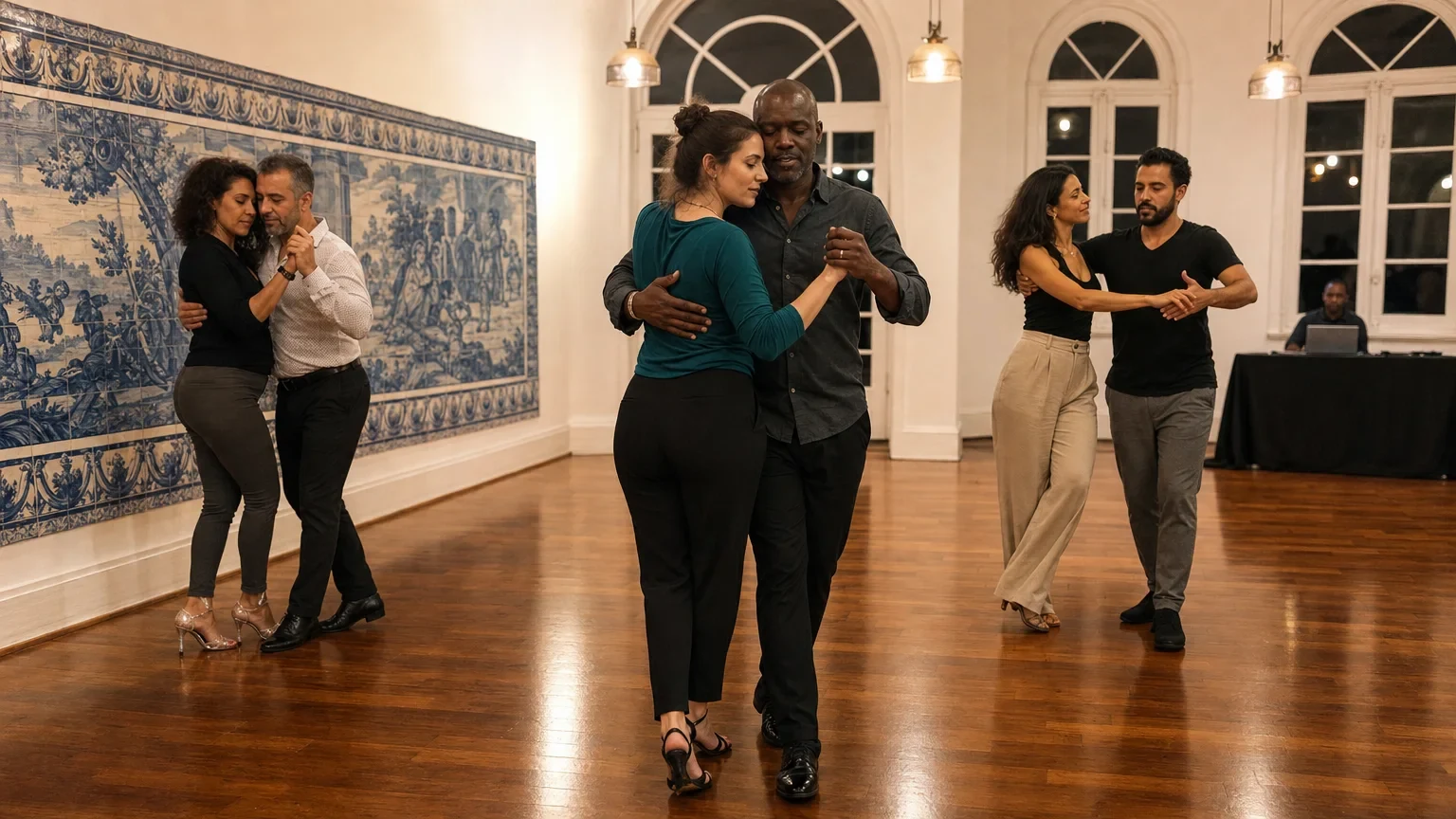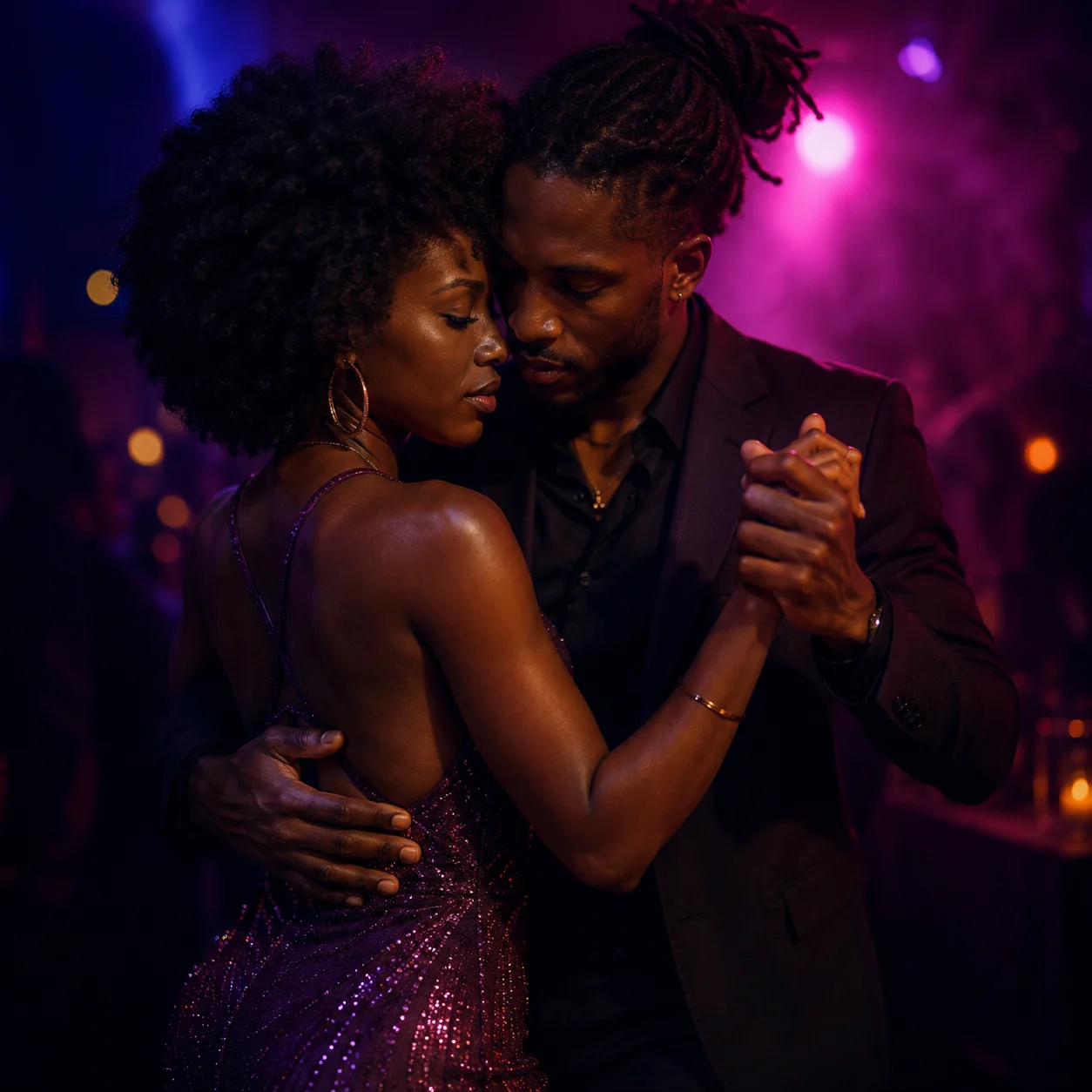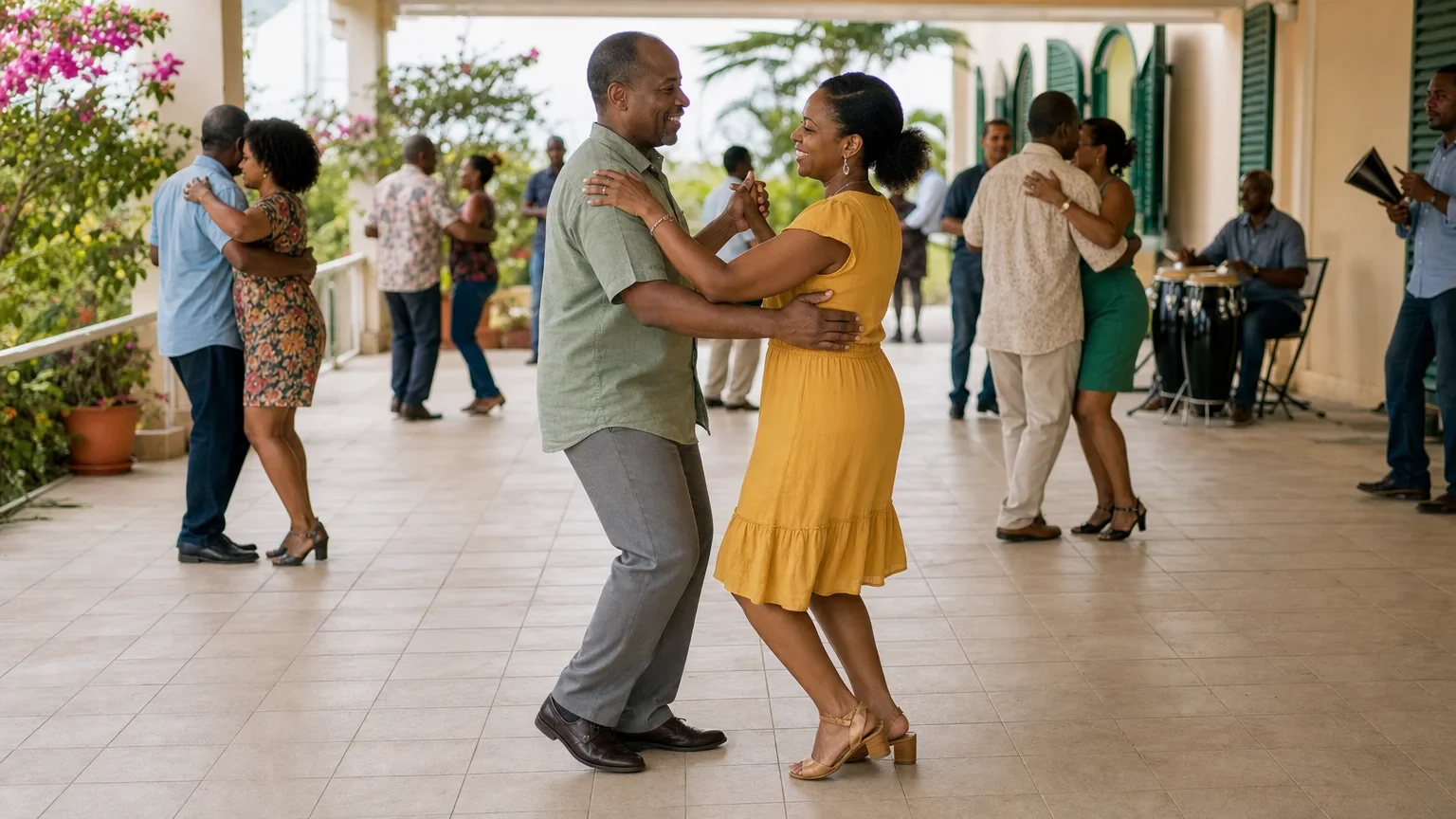
To dance kompa with a partner, find the steady pulse in the bass and drum, then shift your weight from foot to foot on that pulse in small, unhurried steps while your hips carry the movement and your upper body stays calm. Add a relaxed hold, keep your own posture, and let the lead suggest changes of direction through the connection rather than the arms. That is the whole foundation; everything else is refinement.
What makes kompa a partner dance
Kompa (also written konpa or compas) is Haitian dance music, and the dance that goes with it is first of all a couple dance. When UNESCO added the compas of Haiti to its Representative List of the Intangible Cultural Heritage of Humanity in 2025, it described the dance as a rhythmic walk marked by pelvic movement, alternating steps and a physical connection between the dancers. That is a useful definition for a beginner because it names the three things you are actually learning: a walk, a weight change, and a way of staying connected to someone else while you do both.
The same listing notes that the dance is passed on informally, through families, neighbourhoods, schools and artists. In practice that means there is no single official syllabus. Haitian-run studios and teachers in Miami, Paris, Tampa, Brooklyn and elsewhere teach recognisably the same dance, but they describe the details in their own ways. This guide sets out what those teachers agree on, shows where they differ, and labels our own suggestions as suggestions. For the music’s history and the meaning of the name, start with our guide to what kompa is.
Hear the pulse before you move
Kompa is in four-four time and sits at a moderate, walkable tempo. Writing about the music Nemours Jean-Baptiste launched in 1955, the ethnomusicologist Gage Averill describes its “square” pulse as being reinforced by a one-two figure in the bass, with the drum playing a variant of the Dominican merengue pattern over the top. That bass is your anchor. The horns, guitars and vocals carry the melody and the drama; the bass and drum tell your feet when to move.
Before you take a step, listen. Put on a mid-tempo kompa track, tap your foot and nod along until the beat feels inevitable, a tip several teachers give in one form or another. Notice which sounds repeat every bar without changing. Those are the sounds to dance on. Averill reports a saying attributed to Nemours himself: Depi ou konn make pa, ou toujou sou konpa, roughly “as long as you know how to mark a step, you’re in the kompa.” The point is reassuring. If you can walk in time, you can begin.
A listening exercise (our suggestion): play one song three times. The first time, clap only on the beats you are sure of. The second time, step in place on those claps without a partner. The third time, keep stepping and let your hips follow the weight change instead of leading with your shoulders. Three plays of one song will teach you more than ten songs heard once.
The basic: small alternating weight changes
Teachers describe the basic step in slightly different ways, and it helps to know that before you take a class so the variations do not confuse you.
Walking in place
KOTR Dance Studio, a Haitian-run school in Miami’s Little Haiti, calls the basic kare and describes it as a simple left-right pattern that mimics walking in place: shift your weight onto one foot, step in place with the other, and shift back, then add a gentle figure-eight motion of the hips on top. The feet barely travel. The rhythm comes from the transfer of weight, not from the size of the step.
Side, together, rock
The Paris-based kompa teachers Dady and Manuela, as summarised by the dance-tutorial site DanceLifeMap, teach a side step, a closing step with the other foot, and a small rock back onto the first, repeated to the other side. Once that is steady, couples can travel gently forward and back while keeping the side-to-side feel in the hips.
What the two have in common
Both approaches are small, alternating weight changes, which is exactly what UNESCO’s “alternating steps” describes. Historical accounts also describe the dance of Nemours’s era as a two-step, sometimes called kare or carré, the “square”. None of the teaching sources we consulted publishes a fixed count, so do not worry if one teacher counts differently from another.
Our suggestion: begin by letting each change of weight land on a beat you can hear in the bass. When that feels automatic, adopt your teacher’s count and footwork. Keep your knees softly bent so the weight change can travel up into the hips; stiff legs turn the step into a march.
Posture
The teaching descriptions agree on a calm upper body and active hips. DanceLifeMap’s summary of Dady and Manuela recommends an upright frame, relaxed shoulders, slightly bent knees and weight carried towards the balls of the feet, which makes it easier for the hips to move. Brooklyn’s CUMBE dance centre describes kompa as primarily focused on hip movement, and KOTR’s figure-eight hip action sits on top of a quiet torso.
Think of it as two halves of the body with two jobs. Below the waist: weight changes, bent knees, hip motion. Above the waist: steady, tall, relaxed, with the arms forming the hold rather than pumping or steering. Beginners usually reverse this, swinging the shoulders and locking the knees. If you feel your shoulders working, you are probably trying too hard with the wrong half.
The hold and the connection
Kompa is usually danced in a closed hold, and here too descriptions differ in detail. KOTR describes a close embrace with the lead’s right hand on the follower’s lower back, the follower’s other hand resting on the lead’s shoulder or upper arm, and the remaining hands joined. Dady and Manuela place the lead’s right hand around the middle of the partner’s back with the free hands held. Both describe the same idea: one hand on the back, one pair of hands joined, and the follower’s free arm resting on the lead.
How close you stand varies a great deal. Some couples dance with comfortable space between them; others dance very close, especially to slower songs. The best single piece of advice we found comes from Dady and Manuela: come closer if you both want to, but do not cling, and keep your own posture and frame. A good connection is a shared rhythm, not a grip. If you would fall over when your partner let go, you are leaning on them.
Our suggestion for beginners: start with a little space between your torsos so you can see your partner’s feet in your peripheral vision and feel the weight change clearly through the hands and the back. Closeness can come later, by mutual choice.
Leading and following
In KOTR’s description the lead guides and starts turns and patterns, and the follower responds, with changes of weight and direction communicated through the connection between the dancers’ bodies. Michael O’Brian Kibe, a kompa instructor teaching in Nairobi, told Business Daily in 2023 that his classes cover the handling of your partner by learning to anticipate the moves, and that partners communicate without words.
In practice, leading in kompa is quiet. The lead decides when to keep marking time, when to travel a little, and when to turn, and signals it by moving their own centre first, so that the follower feels the change through the back and hands rather than being pushed or pulled by the arms. The follower’s job is not to guess but to stay responsive: keep the basic going, stay on the pulse, and let a change of direction arrive before acting on it. Both roles share responsibility for the timing.
Turns, kept simple
Turns are an addition, not the core. DanceLifeMap’s summary of Dady and Manuela suggests leading a gradual turn and then returning to the basic, and practising in both directions. We found no published standard for how a kompa underarm turn should be led, so learn the mechanics from a teacher in person. Two general principles hold in any partner dance: keep marking the pulse with your feet while you turn, so you come out of the turn on time, and keep turns small and slow on a crowded floor.
Dancing to the music, not just the beat
Kompa can be danced slowly or briskly, and your movement should follow the record. A student guide from the University of Illinois Chicago notes that slow guitar passages can draw dancers into more hip movement. That points to the simplest form of musicality: let the size and texture of your movement follow the energy of the song.
Some practical cues (our editorial suggestions, not rules):
- On a bright, horn-led section, stay crisp and light, with small steps that sit right on the beat.
- On a slower, guitar-led passage, let the hips do more and the feet do less.
- When the band builds up energy, travel a little; when it settles, come back to marking time in place.
- If the band breaks or stops, you can pause with it, then pick the basic back up when the pulse returns.
The aim is for both partners to hear the same changes and respond together. That shared listening is what separates kompa partner dancing from simply swaying to music in someone’s arms. Swaying has no structure; kompa has a pulse, a weight change on that pulse, and a lead and follow that let two people change direction together.
Kompa or gouyad?
Gouyad is part of kompa, not a separate dance. The Haitian newspaper Le Nouvelliste has called it a characteristic trait of kompa dancing, and the Paris organisers Afro Caribbean Nation bill their gouyad class as the more intimate, deeper version of kompa, taught separately from couples kompa. The general kompa partner dance described in this guide is the broader base: a walk-like basic, a relaxed frame, some travel and the occasional turn. Gouyad tends towards slower songs, a closer hold and a hip-led movement that barely travels.
No source we consulted sets a tempo threshold between them, so treat the difference as a tendency. Learn the basic first; gouyad is easier once you can stay on the pulse without thinking. Our guide to gouyad explains the word, its history and how the style feels.
Etiquette on a social floor
We found no published Haitian or kompa-specific code of etiquette, so the points below are general social-dance good practice, offered as such.
- Ask clearly and accept a no gracefully. A simple invitation with an open hand is enough. A polite refusal needs no explanation.
- Let the closeness be mutual. Start with space and let distance change only if both partners are comfortable. As Kibe points out, newcomers sometimes fear kompa is about groping; good dancers prove it is not.
- Dance for your partner’s level. If your partner is new, keep to the basic and simple direction changes.
- Mind the space around you. Keep steps and turns small when the floor is busy.
- Say thank you. End at the close of a song, thank your partner and walk them back towards where you met.
Common beginner mistakes
These come from the teaching sources above and from general partner-dance experience. They are our editorial observations, not a published list.
- Steps that are too big. The basic is close to walking in place. Big steps make you late and crowd your partner.
- Moving the shoulders instead of the hips. The torso stays calm; the motion comes from the weight change.
- Locked knees. Without soft knees the hips cannot move and the step turns stiff.
- Chasing the melody. Stepping to the horns or vocals rather than the bass and drum pulls you off the beat.
- Clinging or leaning. Keep your own balance and frame; connection is not support.
- Leading with the arms. Signal changes through your body, not by pushing or pulling.
- Rushing into gouyad. Closeness and hip-led movement work better once the basic is secure.
Common questions
Is kompa hard to learn?
The basic is one of the more approachable partner-dance foundations, because it is built on walking-in-place weight changes rather than complex footwork. The skill that takes time is staying relaxed, on the pulse and connected to a partner at once.
Do I need a partner to start?
No. You can practise listening, the weight change and the hip motion alone. The hold, leading and following need a partner, ideally in a class.
Is there one correct way to count kompa?
No published standard exists that we could find. Teachers use different counts and footwork for the same basic idea, so follow the teacher in front of you and keep your weight changes on the pulse.
Is kompa the same as merengue?
No, though the two are related. Averill and others trace kompa’s drum pattern to Dominican merengue, but kompa developed its own slower, steadier groove and its own way of dancing. Our kompa guide explains the history.
Sources
Factual statements in this guide draw on the following. Teaching descriptions are attributed to the teachers or schools that published them; points we label as suggestions or editorial observations are our own.
- UNESCO Intangible Cultural Heritage, “The Compas of Haiti”, Representative List, inscribed 2025. The description of the dance and its informal transmission.
- Gage Averill, Konpa ! La musique populaire en Haïti, chapter 4: “Les origines du konpa et de la kadans”, Médiathèque Caraïbe (Laméca), 2016–2019. The square pulse, the bass figure, the merengue-derived drum pattern and Nemours’s saying. Laméca serves this dossier over plain HTTP only.
- KOTR Dance Studio, “What is Konpa: The Heartbeat of Haitian Dance”. The kare basic, hip action, close hold and lead/follow roles.
- DanceLifeMap, “How to Dance Kompa: Basic Steps for Beginners”, a summary of a tutorial by the Paris-based teachers Dady and Manuela. Rhythm, posture, the side-together-rock basic, the hold and turns.
- CUMBE: Center for African and Diaspora Dance, “Compas/Kompas Dance”. Kompa’s focus on hip movement.
- Sinda Matiko, “Haiti’s Kompa joins Nairobi dance scene”, Business Daily Africa, 1 October 2023. Michael O’Brian Kibe on partner handling and newcomers’ misconceptions.
- Cliford Jasmin, “Konpa’s Gouyad Dance Faces No Threat”, Le Nouvelliste, 21 August 2025. Gouyad as a characteristic trait of kompa dancing.
- Ville de Paris, “Initiation au konpa dans le 19e”, event listing for Afro Caribbean Nation. Couples kompa and gouyad taught as separate classes.
- University of Illinois Chicago, School of Literatures, Cultural Studies and Linguistics, “French peer tutor Ketura writes about Konpa”, 15 March 2023. Kompa danced slowly or quickly; the carré two-step; slow guitar passages and hip movement. A student article, used for general description only.
Written and fact-checked by the ZoukAfrobeat editorial team. Teaching descriptions are attributed to the teachers and schools that published them; where they differ, both versions are given. Suggestions, exercises and the list of common mistakes are our own editorial advice and are labelled as such. No interviews were conducted for this article and no quotations are invented. The featured image is an AI-generated photo illustration created for this article; it shows no real dancers, venue or event. See our editorial standards and corrections policy.